Ashwagandha vs Rhodiola: Which Adaptogen Is Right for Your Stress?
Adaptogens have moved from the fringes of Ayurvedic and traditional medicine into the mainstream supplement aisle — and the pace of adoption shows no signs of slowing. As chronic stress, burnout, and sleep disruption have become near-universal complaints, millions of people are looking for something beyond caffeine and willpower. Two herbs consistently rise to the top of that search: ashwagandha and rhodiola. If you’re trying to decide between them, you’ve found yourself in good company — and a genuinely useful comparison to make.
The short answer to “ashwagandha vs rhodiola which is better” is: it depends on the type of stress you’re dealing with. Both are well-studied adaptogens with real clinical evidence behind them. But they work through different mechanisms, suit different stress profiles, and are best used at different times of day. Getting that distinction right can be the difference between a supplement that transforms your energy and one that collects dust on the shelf.
This guide covers the science behind both herbs, honest assessments of the evidence, specific product recommendations, and a decision framework to help you choose — or determine whether combining them makes sense for you.
What Makes Something an Adaptogen?
The term “adaptogen” has a clinical definition that predates the wellness industry’s enthusiasm for it. Soviet pharmacologist Nikolai Lazarev coined the concept in 1947, and it was later formalized by Israeli Brekhman: a substance is an adaptogen if it is non-toxic, produces a non-specific response to stress, and normalizes physiological function regardless of the direction of the stressor.
In modern terms, adaptogens are understood to work primarily through the HPA axis — the hypothalamic-pituitary-adrenal axis, the body’s central stress-response network. When you encounter a stressor, your hypothalamus signals your pituitary gland, which signals your adrenal glands to release cortisol. Short-term cortisol spikes are normal and useful. But when that system runs hot for weeks or months — as it does for most people under chronic modern stress — you get dysregulation: elevated baseline cortisol, disrupted sleep, blunted motivation, and eventually the burnout state that is increasingly well-documented in the literature.
Adaptogens like ashwagandha and rhodiola appear to modulate this response, helping the body mount an appropriate stress reaction without tipping into chronic over-activation. They do this through somewhat different mechanisms, which is why their clinical profiles diverge in important ways.
Ashwagandha: The Calming Adaptogen
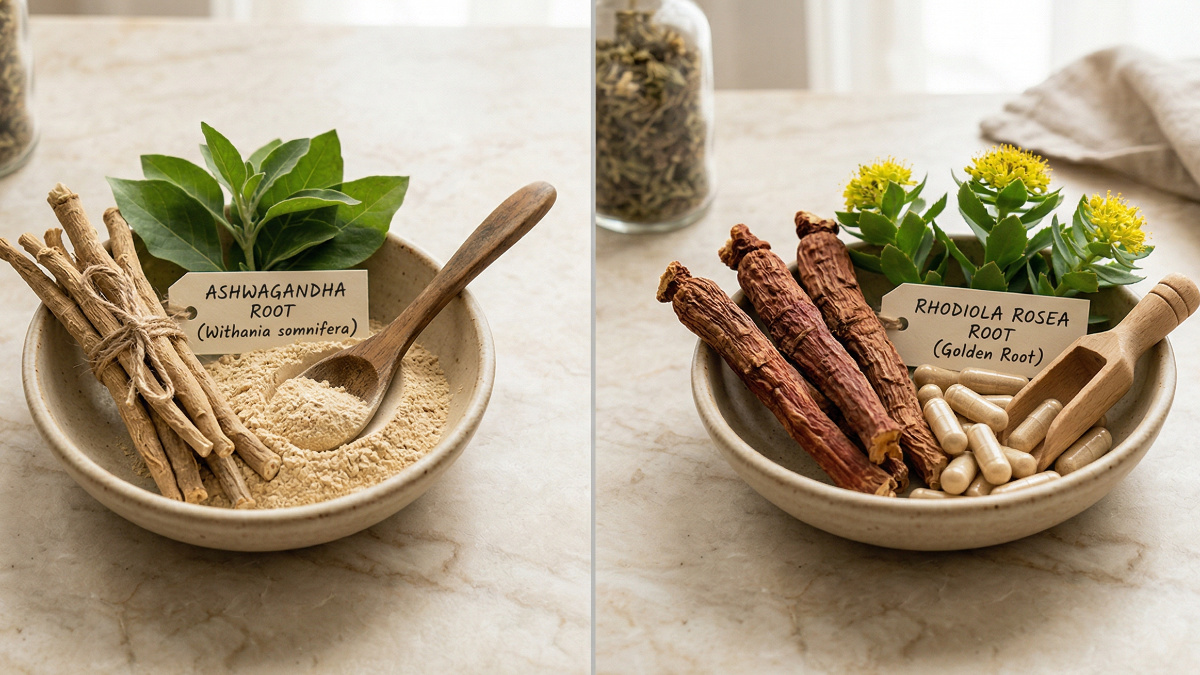
Ashwagandha (Withania somnifera) is one of the most studied herbs in the Ayurvedic pharmacopoeia, and its modern research record is unusually strong for a botanical. The active compounds — primarily withanolides, a class of steroidal lactones — appear to reduce cortisol, modulate GABA receptors, and exert anti-inflammatory effects on the nervous system. The cumulative effect is calming and restorative rather than stimulating.
What the Research Shows
The landmark clinical trial comes from a 2012 study published in the Indian Journal of Psychological Medicine by Chandrasekhar, Kapoor, and Anishetty. The double-blind, placebo-controlled trial enrolled 64 adults with a history of chronic stress and randomized them to either 300mg of a high-concentration ashwagandha root extract (KSM-66) twice daily or placebo. After 60 days, the ashwagandha group showed a 27.9% reduction in serum cortisol relative to baseline — a statistically significant finding. Participants also reported significantly reduced scores on standardized measures of stress, anxiety, and sleep quality. This remains one of the cleanest ashwagandha trials in the literature.
A 2019 study by Lopresti and colleagues, published in Medicine (Baltimore), replicated and extended these findings with a different ashwagandha extract. Using 240mg of KSM-66 daily over 60 days, the researchers observed significant reductions in cortisol, salivary immunoglobulin A, and self-reported stress — suggesting that the benefits aren’t simply subjective. A more recent 2023 trial by Majeed and colleagues, also in Medicine (Baltimore), using 240mg of Sensoril ashwagandha (a different standardized extract from the leaves and roots), found improvements in stress, anxiety, and quality of life scores over 60 days, with good tolerability.
The NIH Office of Dietary Supplements, reviewing the cumulative evidence, concluded that ashwagandha may be helpful for stress and anxiety, and that several well-designed trials support a modest to moderate benefit. That’s a careful and accurate characterization — the evidence is solid for a botanical, even if the effect sizes are not as dramatic as pharmaceutical anxiolytics.
Who Ashwagandha Is Best For
The clinical profile points to a specific stress archetype: the person who is wired but can’t unwind. If your stress manifests as racing thoughts at night, difficulty falling asleep despite exhaustion, heightened anxiety, or a sense of sustained nervous system overdrive, ashwagandha is likely the better fit. Its cortisol-lowering and GABAergic effects directly address overstimulation.
It’s also a good choice for:
- People with elevated baseline anxiety who want a non-sedating calming effect
- Those whose sleep disruption is stress-driven (rather than structural)
- Athletes in heavy training blocks who want to support recovery and reduce cortisol-mediated muscle breakdown
- People who feel burned out in the anxious, hypervigilant sense — rather than the flat, depleted sense
Dosing and Extract Quality
Dosing matters enormously with ashwagandha. The clinical evidence is concentrated around two standardized extracts:
- KSM-66: A root-only extract standardized to ≥5% withanolides. Most trials use 300–600mg daily, often split into two doses. This is the most widely studied form.
- Sensoril: A root-and-leaf extract standardized to ≥10% withanolides. Effective at lower doses, typically 125–250mg daily, due to higher withanolide concentration.
Generic ashwagandha powder without standardization or third-party testing is a gamble. The withanolide content of unstandardized root powder varies widely, and many low-cost products are significantly underdosed relative to the clinical trials. For a deeper comparison of these two extracts, see our dedicated guide: KSM-66 vs Sensoril: Which Ashwagandha Extract Is Better?
Best Ashwagandha Products
Momentous Ashwagandha — Uses KSM-66 at a clinically relevant 300mg dose, third-party tested by NSF Certified for Sport. Momentous has built a reputation on using trademarked, research-backed ingredients without proprietary blends, which makes it easy to verify you’re getting what the label claims. A reliable choice for athletes and professionals who want supply chain transparency.
Onnit Ashwagandha — Also uses KSM-66, dosed at 300mg per capsule. Onnit’s formulation is straightforward, and the brand has been consistent about using standardized extracts. A solid option if you’re already in the Onnit ecosystem or prefer their capsule format.
Gaia Herbs Ashwagandha Root — Uses a concentrated liquid extract made from organic ashwagandha root, standardized and tested in Gaia’s own ISO-certified lab. For consumers who prioritize organic sourcing and a vertically integrated supply chain (Gaia grows many of its own herbs), this is one of the more trustworthy options on the market. The liquid phyto-caps have good bioavailability.
Rhodiola: The Energizing Adaptogen
Rhodiola rosea is a hardy plant native to the cold mountainous regions of Europe and Asia, used for centuries in Scandinavian and Russian traditional medicine to combat fatigue and improve resilience. Where ashwagandha calms, rhodiola activates — it’s considered a stimulating adaptogen, working through pathways that enhance energy metabolism and protect the nervous system under load.
The primary active compounds are rosavins (a class of phenylpropanoids) and salidroside (a phenylethanol glycoside). These appear to influence monoamine neurotransmitters — dopamine, serotonin, and norepinephrine — and to modulate the stress-response protein HSP70, which helps cells recover from stress-induced damage.
What the Research Shows
A 2012 systematic review by Ishaque and colleagues, published in BMC Complementary and Alternative Medicine, evaluated 10 randomized controlled trials of rhodiola for physical and mental fatigue. The review found consistent evidence that rhodiola reduces mental fatigue — particularly under conditions of acute stress or sleep deprivation — and modestly improves physical endurance. Effect sizes were generally small to moderate, but methodologically the trials were reasonably well-designed by botanical standards.
The fatigue-related findings are among the most replicated in the rhodiola literature. Multiple trials have shown that rhodiola taken before cognitively demanding tasks — including overnight shift work, exam periods, and military exercises — reduces self-reported fatigue and improves performance on cognitive tests. The onset is also faster than ashwagandha: some studies document acute effects within a single dose, though cumulative benefits build over weeks.
It’s worth being honest about where the evidence thins out. The rhodiola literature has fewer large, well-powered trials than ashwagandha. Standardization across studies varies, and some trials have used proprietary blends that make it difficult to isolate the active ingredient. The overall picture is promising and mechanistically coherent, but rhodiola doesn’t yet have the depth of clinical backing that the best ashwagandha extracts do.
Who Rhodiola Is Best For
Rhodiola’s clinical profile maps to a different stress archetype: the person who is depleted rather than overstimulated. If your stress has hollowed you out — leaving you flat, unmotivated, mentally foggy, and physically tired even after rest — rhodiola addresses that state more directly than ashwagandha.
It’s a strong fit for:
- People experiencing burnout characterized by low energy and emotional blunting
- Those who need to sustain cognitive performance under pressure (deadline-driven knowledge workers, students, medical professionals)
- Athletes dealing with overtraining syndrome or sustained physical fatigue
- People who feel their “battery” is perpetually low, rather than perpetually overcharged
A key practical note: because rhodiola has mild stimulating properties, most people do better taking it in the morning or early afternoon. Taking it too late in the day can interfere with sleep — the opposite of what ashwagandha tends to do.
Dosing and Extract Quality
Clinical trials have generally used 200–600mg of rhodiola extract per day, standardized to 3% rosavins and 1% salidroside — a ratio that reflects the natural composition of the root and has become the de facto standard for quality products.
Lower doses (200–400mg) are often effective for acute fatigue and cognitive performance. Higher doses (400–600mg) may be needed for sustained adaptogenic effects. Because rhodiola can have a stimulating effect, starting at a lower dose and titrating up is a reasonable approach.
As with ashwagandha, unstandardized rhodiola products are unreliable. The rosavin and salidroside content of unspecified “rhodiola root powder” varies dramatically by growing region, harvest timing, and processing. Stick to products with explicit standardization.
Best Rhodiola Products
Momentous Rhodiola Rosea — Standardized to 3% rosavins and 1% salidroside, NSF Certified for Sport tested. Momentous applies the same ingredient discipline to rhodiola that it does to its ashwagandha products, making this a trustworthy standalone option if you want a single-ingredient format with clean sourcing.
Gaia Herbs Rhodiola Rosea — A concentrated extract made from organically grown rhodiola, standardized and produced in Gaia’s own facilities. For consumers who value whole-plant extraction methods and organic certification over a purely isolate-based approach, Gaia’s rhodiola is one of the better options available.
Ashwagandha vs Rhodiola: Head-to-Head Comparison
| Factor | Ashwagandha | Rhodiola |
|---|---|---|
| Primary mechanism | HPA axis modulation, cortisol reduction, GABAergic activity | Monoamine neurotransmitter support, HSP70 modulation, anti-fatigue |
| Direction of effect | Calming, restorative | Energizing, stimulating |
| Best for | Anxiety, sleep disruption, overstimulation | Burnout, mental fatigue, brain fog |
| Onset | Gradual (2–4 weeks for full effects) | Can be acute (single dose); builds over weeks |
| Best time to take | Evening or before bed | Morning or early afternoon |
| Clinical evidence depth | Strong — multiple well-powered RCTs | Moderate — consistent but smaller trials |
| Standard dosing | 300–600mg KSM-66; 125–250mg Sensoril | 200–600mg (3% rosavins / 1% salidroside) |
| Common side effects | GI upset at high doses; rare thyroid interactions | Mild stimulation, occasional dizziness at high doses |
| Contraindications | Caution with thyroid conditions, autoimmune disease, pregnancy | Caution with bipolar disorder; may interact with stimulants |
| Approximate monthly cost | $25–$50 for quality single-ingredient products | $20–$45 for quality single-ingredient products |
Can You Take Both? The Case for Stacking
The answer is yes — and for many people with complex stress profiles, stacking ashwagandha and rhodiola makes more sense than choosing one. The two herbs are complementary rather than redundant: they work through different mechanisms, suit different parts of the day, and address different aspects of the stress response.
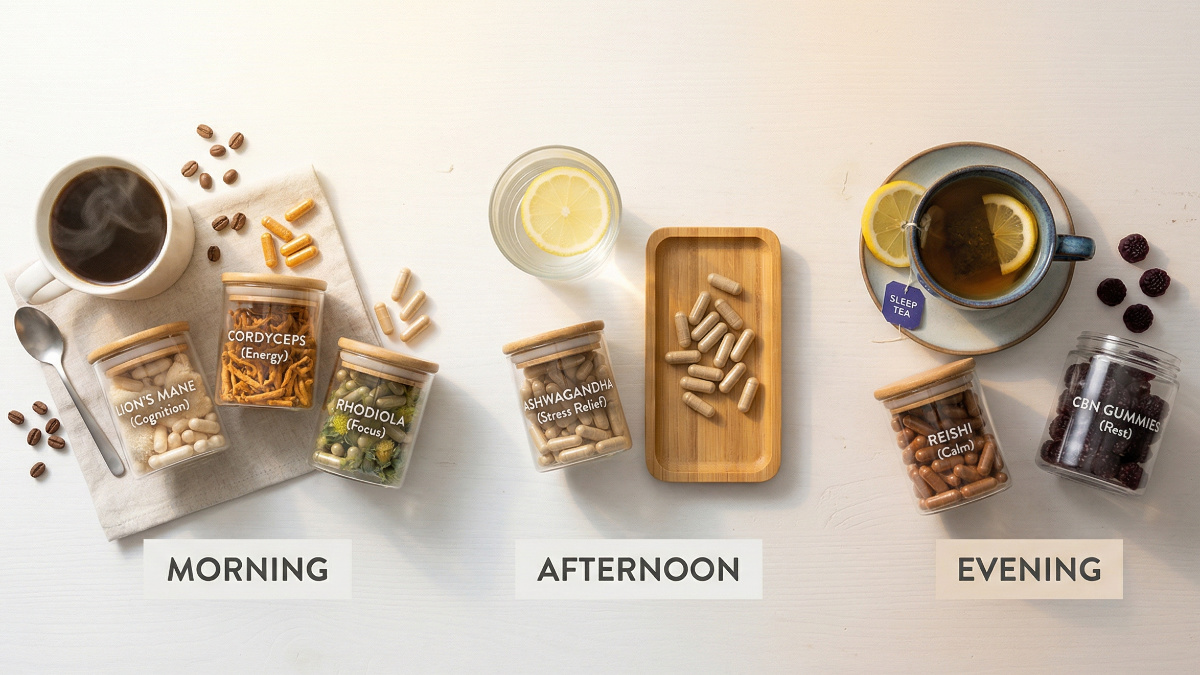
The most common and well-reasoned protocol is rhodiola in the morning, ashwagandha in the evening:
- Morning: Rhodiola (200–400mg) taken with or shortly after breakfast. Supports mental clarity, energy, and stress resilience throughout the workday without overcaffeinating.
- Evening: Ashwagandha (300mg KSM-66) taken with dinner or before bed. Supports cortisol wind-down, reduces the physiological activation that interferes with sleep, and provides the sustained adaptogenic effect overnight.
This protocol addresses the full arc of the modern stress day: performance support in the first half, recovery support in the second. It’s a protocol that has been adopted by a number of integrative practitioners and that the evidence, while not directly testing the combination, mechanistically supports.
If you’d prefer a pre-formulated stack that includes both (along with other well-studied adaptogens), two products are worth considering:
Neurohacker Collective Qualia Resilience — Contains both KSM-66 ashwagandha and rhodiola alongside a broader set of adaptogens and nootropics. Neurohacker’s formulation philosophy emphasizes ingredient synergy and they publish their rationale openly. The multi-ingredient approach is harder to titrate than single-ingredient products but convenient for people who prefer a single capsule protocol.
Momentous Adaptogen Stack — Momentous has a combined formulation designed around the morning/evening logic described above. Given Momentous’s sourcing standards (NSF Certified for Sport), this is a good option for athletes or anyone who wants supply chain accountability on a multi-ingredient product.
For a broader view of how adaptogens fit into a complete supplement protocol, see our guide on building the ultimate wellness stack.
Decision Framework: Which Adaptogen Is Right for You?
Use this decision tree to identify your starting point.
START: What best describes your primary stress symptom?

├── "I feel anxious, tense, or unable to switch off"
│   └── → START WITH ASHWAGANDHA
│       ├── Take in the evening
│       ├── Use KSM-66 (300–600mg) or Sensoril (125–250mg)
│       └── Reassess after 4–6 weeks
│
├── "I feel flat, depleted, mentally foggy, or burnt out"
│   └── → START WITH RHODIOLA
│       ├── Take in the morning
│       ├── Use 200–400mg standardized to 3% rosavins
│       └── Reassess after 4–6 weeks
│
├── "I have both — I'm wired during the day but crash, or I'm anxious AND fatigued"
│   └── → CONSIDER STACKING BOTH
│       ├── Rhodiola AM + Ashwagandha PM protocol
│       └── Or use a pre-built stack (Qualia Resilience, Momentous Adaptogen Stack)
│
└── "I'm not sure / my stress is physical (training, overexertion)"
    ├── Primarily mental recovery? → Ashwagandha
    └── Primarily performance & anti-fatigue? → Rhodiola
A note on timing expectations: Neither herb is a fast-acting anxiolytic or stimulant in the pharmaceutical sense. Ashwagandha’s cortisol-lowering effects typically require 4–8 weeks of consistent use to become clinically meaningful. Rhodiola’s acute effects on fatigue can appear sooner, but the adaptogenic benefits build cumulatively. Give either intervention at least four weeks before evaluating whether it’s working.
A Note on Safety
Both ashwagandha and rhodiola have strong safety profiles in the published literature, with side effects generally mild and dose-dependent. That said, several groups should exercise caution:
- Ashwagandha: Contraindicated during pregnancy. Use caution with thyroid conditions (ashwagandha may affect thyroid hormone levels) and autoimmune diseases (it may stimulate immune activity). Rare cases of liver injury have been reported — the evidence is preliminary, but people with liver conditions should discuss with a clinician.
- Rhodiola: May have mild stimulant-like effects that interact with stimulant medications or worsen agitation in individuals with bipolar disorder. Start at lower doses if you’re sensitive to stimulants.
This article is for informational purposes only and does not constitute medical advice. Before starting any new supplement, consult with a qualified healthcare provider — particularly if you take prescription medications, have a chronic health condition, or are pregnant or breastfeeding.
Frequently Asked Questions
Is ashwagandha or rhodiola better for anxiety?
Ashwagandha has the stronger clinical evidence for anxiety specifically. Multiple placebo-controlled trials, including the widely cited 2012 Chandrasekhar study, have documented significant reductions in anxiety scores alongside measurable cortisol reductions. Rhodiola has some evidence for stress resilience and emotional regulation, but its primary studied application is fatigue reduction rather than anxiety. If anxiety is your primary concern, ashwagandha — particularly KSM-66 or Sensoril — is the better-evidenced choice.
Can you take ashwagandha and rhodiola together?
Yes. The two adaptogens work through different mechanisms and are complementary rather than overlapping. The most common protocol is rhodiola in the morning (for energy and mental performance) and ashwagandha in the evening (for cortisol wind-down and sleep support). There are no known interactions between them. Several pre-formulated stacks combine both, including Neurohacker Qualia Resilience and products from Momentous.
Which adaptogen is best for stress?
“Stress” covers a wide range of states. Ashwagandha is better supported for the over-activated, cortisol-driven stress response — anxiety, sleep disruption, racing thoughts. Rhodiola is better supported for fatigue under stress — depleted energy, brain fog, physical exhaustion. The “best” adaptogen depends on your stress phenotype. If you experience both, a morning rhodiola / evening ashwagandha stack addresses the full picture.
Does rhodiola help with burnout?
Rhodiola has the best evidence among adaptogens for burnout characterized by fatigue, low motivation, and cognitive impairment. The 2012 systematic review by Ishaque and colleagues found consistent reductions in mental fatigue across multiple trials, and several studies have specifically tested rhodiola in occupationally stressed populations (medical staff, shift workers, students during exam periods) with positive results. For burnout with a significant anxiety or sleep component, pairing rhodiola with evening ashwagandha may be more effective than either alone.
What is KSM-66?
KSM-66 is a patented, standardized ashwagandha root extract produced by Ixoreal Biomed. It is standardized to contain at least 5% withanolides — the primary bioactive compounds in ashwagandha — and is among the most extensively clinically tested ashwagandha formats available. Multiple independent trials have used KSM-66 specifically, which is why it appears in the majority of evidence-based ashwagandha recommendations. It is distinct from Sensoril, which is derived from both roots and leaves and standardized to a higher withanolide percentage at lower doses. For a full comparison, see our guide: KSM-66 vs Sensoril: Which Ashwagandha Extract Is Better?
How long does it take for adaptogens to work?
Rhodiola may produce acute effects on fatigue and cognitive performance within a single dose, though sustained adaptogenic benefits build over weeks of consistent use. Ashwagandha typically requires 4–8 weeks of daily use before clinically meaningful cortisol reduction and stress relief are apparent. Both herbs reward consistency over time rather than occasional use.
Are there any side effects to worry about?
Both herbs are well-tolerated at clinical doses in healthy adults. Ashwagandha occasionally causes GI discomfort at higher doses; taking it with food typically resolves this. Rare cases of liver injury have been reported with ashwagandha, though causality has not been firmly established — people with liver conditions should discuss with a clinician. Rhodiola can cause mild stimulation, which is why it’s best taken earlier in the day; people sensitive to stimulants may notice agitation at higher doses. Pregnant individuals should avoid ashwagandha.